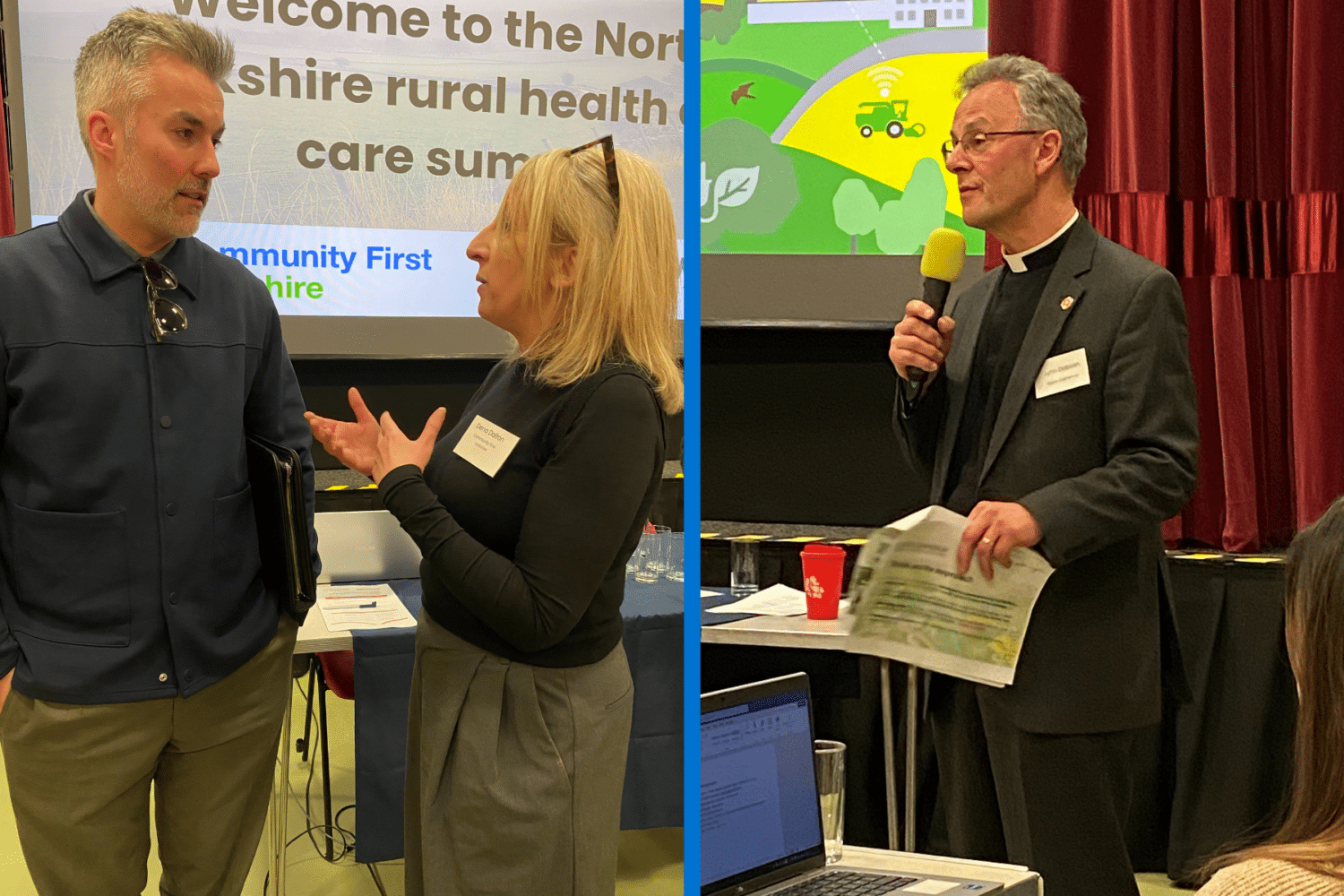
On Friday 21 March, leaders from the NHS, North Yorkshire Council, the VCSE sector, rural organisations and our national parks, gathered at the Galtres Centre in Easingwold to explore a shared understanding of rural health inequalities and how we can work better together to address the impact of them. Organised by Community First Yorkshire and Healthwatch North Yorkshire, the North  Yorkshire Rural Health and Care summit was a dynamic discussion on rural healthcare challenges and solutions.

Dena Dalton, Head of Health Collaboration at Community First Yorkshire, shares her thoughts about the event.

Rural healthcare: more than just medicine

One key theme from the summit was that rural healthcare isn’t just about improving access to healthcare services. Transport, digital access, community support, housing, and infrastructure all play critical roles in health outcomes. When it does come to healthcare though, many rural residents feel ignored, as Ashley Green, CEO of Healthwatch North Yorkshire, pointed out.

Access is a major issue – people often have to travel 50+ miles for hospital appointments, and there is a shortage of local GPs. Community transport services are a lifeline – where they are funded to exist, yet digital connectivity remains a challenge. Poor broadband access limits online healthcare services, which are becoming increasingly essential.

The cost of rural healthcare

Providing healthcare in rural areas is more expensive than in urban settings, especially given the higher proportion of older adults. York and North Yorkshire Combined Authority Mayor, David Skaith, reiterated the importance of housing and transport in improving health in rural areas and is developing ways to address these. Additional new interventions from the authority include a Men’s Mental Health Task Force and plans to establish a Sports Council to promote early intervention in health issues.

Richard Webb, Corporate Director of Health and Adult Services at North Yorkshire Council, reminded us that older residents are vital in keeping communities connected. He challenged stereotypes about ageing and emphasised that rural inequalities look different and require specific attention. He also suggested that rural housing should be commissioned in partnership with VCSE organisations.

Rural isolation and mental health

Debbie Swales, CEO of Revival North Yorkshire, shared a moving account of how older people in rural communities experience isolation, leading to poorer health outcomes. As she put it, rural North Yorkshire may look like a ‘chocolate box’ environment, but for the elderly, the view often changes – and not always for the better.

The Very Reverend John Dobson, Dean of Ripon and Chair of the North Yorkshire Rural Commission highlighted the mental health struggles of farming communities. He called for the government to recognise digital connectivity as a fundamental right and to scrutinise rural strategy with a health focus. Without affordable housing, many rural communities risk decline.

Challenges in primary care

Simon Stockhill, GP and Chair of the Humber and North Yorkshire Primary Care Collaborative, illustrated the daily reality for GPs, pointing out vast geographic disparities in doctor availability. Scarborough, for instance, has significantly fewer GPs per capita than Harrogate. He emphasised the importance of integrating primary care, communities, VCSE organisations, and care sectors to address health inequalities effectively.

Helen Flynn, CEO of Nidderdale Plus, noted the increasing demand for digital support, as many older people struggle with the shift to online healthcare services. Meanwhile, Ivan Annibal from the National Centre for Rural Health and Care identified workforce shortages as the most pressing issue in rural healthcare. The cost of living in rural areas is high, making it difficult to attract and retain healthcare professionals.

My key takeaways

The lively panel discussions and table debates throughout the summit led to some clear conclusions:

  • No one should be disadvantaged by where they live
  • Rural healthcare is complex and varies by location
  • Innovation is key in rural health, and risk-taking is necessary
  • Rural communities are valuable resources that need greater support
  • Addressing rural deprivation requires stronger advocacy
  • We must push for better rural housing to improve health outcomes.
What’s next?

Insights and feedback from this summit are still being collated and will feed into a dedicated rural health and care plan. At the event, there was a commitment to revisit the Rural Commission’s findings, ensuring health plays a larger role in rural strategy. Councillor Michael Harrison, chair of the North Yorkshire Health and Wellbeing Board, thought this was also a good opportunity to reset the Board. All partners present committed to supporting change in some way, including building on new connections made, developing further knowledge through shared resources, and looking at ways in which secondary care can support in making appointments more accessible to rural populations. We will keep you posted as to what more comes from it.

If you want to discuss the event in more detail, please email Dena Dalton, Head of Collaboration at Community First Yorkshire.

On 22 April, Humber and North Yorkshire Health and Care Partnership’s Voluntary, Community and Social Enterprise (VCSE) Collaborative brought representatives from the VCSE sector together, in Hull, for the first Humber and North Yorkshire VCSE Expo.

The VCSE Collaborative welcomed Stephen Eames CBE, Chief Executive, and Amanda Bloor, Deputy Chief Executive, Humber and North Yorkshire Health and Care Partnership, to engage in conversation with attendees about the VCSE sector’s involvement in the design and delivery of health and care in our region. These discussions provided insight into the challenges facing health and care, and offered reassurance that the VCSE sector is an essential partner within the integrated care system. There was a clear commitment to developing greater collaboration as we move forward, and recognition of the work the VCSE sector can deliver.

‘Conversational spaces’ held during the event were also a highlight and provided attendees with the opportunity to share their experiences, knowledge and ideas around the following topics:

  • Health Inequalities – how is the VCSE sector supporting people and communities to tackle health inequalities?
  • Integrated Care Board/Place – Exploring how the ICB connects with the VCSE at place level.
  • Communications – how does the VCSE Collaborative ensure their communications meet the needs of the VCSE sector?
  • Representation – what are the opportunities and how are they best managed?
  • Place-based Assemblies – exploring what each assembly needs to function effectively.
  • Volunteering – How do we work as a system to create a high quality volunteer offer?
  • Workforce/People – Discussing opportunities such as wellbeing, training, staff movement and placements.
  • VCSE Collaborative – what do you want to see from the VCSE Collaborative going forward?
Showcasing the VCSE sector’s work in health and care

To highlight the VCSE sector’s expertise and knowledge in the delivery of health and care across our region, the VCSE Collaborative commissioned a series of short videos to show as part of the Expo. The videos provide insight into the importance of the VCSE sector’s role in the design and delivery of health and care and capture the breath of the sector’s work across our region. View each video below:

What next?

Feedback from attendees gathered during and after the event is now being reviewed and will form an action plan for the VCSE Collaborative to deliver. This will be shared on the VCSE Collaborative website and through their newsletter.

To discover more about the VCSE Collaborative’s work, visit their website.

If you have any questions about the VCSE Collaborative’s work, please email: hnyicb.vcseteam@nhs.net


Last week (10 November) the Chief Medical Officer, Professor Sir Chris Whitty, launched his annual report: Health in an Ageing Society.

Dena Dalton, Head of Health Collaboration at Community First Yorkshire, shares her thoughts and response to the report below:

Why is this report relevant to the VCSE sector? Why should people read it?

The aim of the report is to concentrate on issues looking at improving the quality of life in an adult’s later years. The Chief Medical Officer (CMO), Professor Sir Chris Whitty, states that improving the quality of life can broadly be divided into two key approaches: 1) things which reduce disability and ill health, and 2) things which can be done to adapt the environment to allow an individual (with a set amount of disability) in older age to live as independent and enjoyable a life as possible.

The report states that the expansion of longer periods of older age living with disease and disability are not inevitable and that compression of morbidity so that people spend less time living with ill health is entirely realistic and, as such, should be a major aim of policy and medical practice.

Very often, our sector is closest to communities

This is why this report is so relevant to the VCSE sector. Charities, voluntary organisations and community groups are closest to older adults due to the communities they work within and the relationships they hold within those. By 2043, it is estimated that 33% of the demographic of North Yorkshire will be over 65 years with many living in rural and coastal areas, where there is less access to health and care services.

The VCSE sector is ideally placed in supporting the prevention of onset of disability and disease through the range of person-centred services, activities and interventions they provide. The CMO identifies the concern around the rise in mental health conditions in older age and key to improving an overall quality of life in people’s later years, there needs to be a renewed focus on mental health improvement interventions. We know that contributory factors to poor mental health include social isolation, reduced mobility and declining physical health and we also know that interventions that help to address these factors are already in evidence in village halls, community hubs and within organisations themselves – all designed, developed and delivered by the sector.

Familiarise yourself with the report. Little of it will be a surprise, yet being able to amplify the evidence and messages that arise from it will help to influence the change that is needed to shift the dial to a prevention focus so that adding life to years becomes the reality.

Is there anything else we think should have been considered for the sector in the report?

There is actually little consideration for the valuable role that the VCSE sector contributes in enabling older adults to spend less time living with ill-health. It is a report very much focused on the medical profession, social care and central and local government. It misses an opportunity to look more holistically on prevention and, instead, tends to look through a more medicalised lens. Social care is mentioned, yet we must ensure partners separate out social care from the VCSE sector and there is clarity about the differences between the two.

What are the next steps? For the sector? And what could the Government be doing next?

Prevention! Prevention! Prevention!

The Government’s dial needs to be left-shifted and resource focused into community services and interventions. Bold and ambitious funding decisions need to be made and acceptance that outcomes will follow, yet will take time.

The sector needs to demonstrate and communicate more effectively the impact they are having within their communities and align that impact with wider system priorities. It is almost impossible to measure something that didn’t occur (i.e. declining physical and mental health), yet what can be measured is the impact that the intervention is having on an individual (e.g. Rockwood Frailty Scale, wellbeing scales etc). The VCSE sector is already delivering many prevention interventions, yet cannot do more without adequate resource investment.

In order to carry out the recommendations within the report, the sector needs to ensure it works effectively with system partners. This is the aim of integrated care systems, yet we need to ensure that the VCSE sector is seen and treated as an equitable partner. We need to ensure that in our interactions with health partners we are referencing the report. If not, there is the real risk that many of the recommendations made within the report will not become a reality.


If you’d like to have further discussions with Dena about her insights on the report, do get in touch by email: dena.dalton@communityfirstyorkshire.org.uk

David Sharp, Chief Executive at North Yorkshire Youth, attended one of our Down to Earth outdoor nature-based wellbeing sessions for leaders. Here he describes his emotional journey from storm to wood whittling to calm:

It’s a stormy start

A stormy day – specifically Storm Nigel saying hello – was the back drop to the second Down to Earth session being run by JK from Where the Mind Grows.

The session used nature to inspire wellbeing and give leaders a practical set of ‘value’ resources to take away.

So, in the intermittent bright sunshine and howling rain I made my way to Little Seed Field near Galphay, avoiding the sheep, tractors and squirrels. I was met by the ever smiling JK with a brew and an amazing view across the valley. It wasn’t raining at this point!

Having settled in and gone through the obligatory intros and welcomes to the other participants, we sat down to do some real work, with a soundtrack of banging doors, driving rain and a very grim view.

Goldilocks and personal values

JK asked us to look at how our personal values can be a living part of a strong wellbeing culture. The exercise gave me time to think about my own personal values, how I work, how I want people to perceive my actions and how my behaviours are linked inextricably to those values. We were asked to come up with 10 ‘value chips’. The first four were easy! It got a little harder after that but eventually I got there. We then had to think about how we were feeling at that moment and put the value chips on a compass. So which values were we focusing on too much, too little and, as Goldilocks would say, what was ‘just right’. As with all these types of things it depends on the situation you are in, how the day is going and such. In that way it’s a really brilliant tool to help determine what is happening right now and certainly something I will take away. As I reflect on a particularly tough day, I’ll use the exercise to help me understand what is going on.

Seeing the wood (whittling) for the trees

To finish the afternoon, we spent some time with Melanie and Claire from Thrive Outside. This session was all about practical things to help us place ourselves in the now. Our focus was on finding a piece of wood we could then create something from, using splitting techniques, whittling, rasping and filing to turn that ‘stick’ into something recognizable. The group chose to make knives, plant name markers, dibbers and spatulas. Using skills taught by Melanie and Clare, we actually managed to produce something resembling the perfect item we saw within the wood. For me, the finished article certainly looked better in my head, maybe just a bit more practice needed. To aid with the creative thinking, raspberry pancakes made on an open fire along with a beverage of choice certainly gave the energy needed. That, along with a gloriously sunny end to the afternoon, made the whole day a very enjoyable experience.

What’s your internal weather map like?

Reflecting on the session, JK started the day by asking what our internal weather map was looking like. Mine was very much around the eye of a storm with a small bit in the middle where I was sitting at that moment and all the chaos around me, getting ready for AGM’s, Board meetings and holiday. At the end of the day, the focus on myself really made a difference and I think that the actual weather was a mimic of my state of mind starting with a stormy, windy and chaotic feeling and then moving into sunny, relaxed and calm.

So thanks to JK, Melanie and Claire (along with everyone else on the day) for helping me find that sunny spot next to the pond.


If you’d like to explore your Leadership wellbeing by connecting with nature, there are places still available on the next two Down to Earth sessions:

I’m not sure which button I’ve inadvertently pressed on my phone but I now regularly receive reminders that this is the International or National Awareness day/week/month for… well lots of worthwhile and, in some cases, intriguing causes. Personal favourites have included 4 July ‘Eat an Extra Dessert day’ and 7 July ‘World Chocolate Day’.

October is World Menopause Awareness Month, with Menopause Awareness Day UK taking place on 18 October. Menopause, the biological stage in a woman’s life that occurs when hormones change and eventually menstruation stops, is medically defined as the ‘day’ a woman has not had a period for 12 consecutive months. This is something I hadn’t realised until I took part in Menopause Champion training earlier this year. I also hadn’t realised that menopausal women are the fastest growing workforce demographic in the UK, particularly in the voluntary and health sectors.

So how much do you know about menopause?

Here‘s a little quiz that was part of the menopause training I went on that was used to prompt discussion about our own awareness.

Why not grab a cuppa and a few minutes and see how much you know.

You will have to mark your own answers and there are no prizes but you may know more than you realised and it could help raise awareness of aspects of menopause and support, if needed, for family, friends and colleagues experiencing their own unique and often intriguing journey through this time.

1. What’s the average age of menopause in the UK? (answer in years)

2. How many people are affected by menopause symptoms at work? ( ? / 10)

3. How many women experience menopause symptoms? (? /4)

4. Name five symptoms of the menopause?

5. What is perimenopause?

6. What percent of women go through early menopause?

7. Why might someone go through an early menopause?

8. What are the three key hormones that play a part in the menopause transition?

9. Name at least three lifestyle changes someone should consider to support themselves through menopause? (up to 3 points)

10. What is andropause?

The answers are below.

How did you do??

I’ve come to learn from my own, and talking to others, that everyone’s menopause experience is different. We all have different views, philosophies and medical histories that will determine our unique journey.

Brain fog can lead to some frustrating and funny moments., Flushes can arrive at the most inconvenient of times, and disturbed sleep –well that can be very challenging not only for the person experiencing this symptom but also those around them. It’s often hard to feel experienced, knowledgeable, empowered, capable and fabulous but that’s what we are. The hot flushes are after all really just power surges!

If you would like to find out more about menopause there are a wealth of resources available, particularly during Menopause Awareness month. Humber and North Yorkshire Health and Care Partnership are running a festival of events around menopause, or why not take a look at the menopause hub on Henpicked’s website here?


Answers

1. 51 – 8 out of 10 menopausal women are in work at this age and have a life expectancy of 83. In fact, this is likely to be a half-way point of life for many women as there is a one in six chance of living to be a 100.

2.  Eight out of 10.

3. Three in every four.

4. Difficulty sleeping, insomnia or fatigue, hot flushes during the day or night, low mood, depression or changes in mood, nervousness, worry or anxiety, reduced ability to concentrate or focus, problems with memory recall, migraines or headaches, aches and pains, urinary issues, e.g. increased frequency, and this is to name just a few.

5. The time leading up to menopause.

6. 5% before the age of 40.

7. POI (Premature Ovarian Failure)/Surgery/medication.

8. Oestrogen, progesterone, testosterone.

9. Exercise/diet/quitting smoking/reducing alcohol/extra calcium/vitamin D/supplements.

10. Andropause is the age-related decline in hormones men go through. In an otherwise healthy male, they would not normally experience menopause-types symptoms as the change in hormones is much slower and a gentle decline. However, there are conditions such as testosterone deficiency syndrome and hormone therapy for things like prostate cancer treatment that could bring about menopause type symptoms. We also need to understand that not everyone experiencing menopause identifies as a woman but may still have the appropriate biological make-up to experience menopause.

We’ve been through a lot these last couple of years. COVID has not gone away, not at all, but we are beginning to live with it. To do this we need to be at the top of our game, physically and mentally.  So for this years Men’s Health week, 13-19 June, it’s time for men everywhere to give yourselves an MOT. Macmillan estimates that across the UK there are around 50,000 ‘missing’ cancer diagnosis’, meaning that compared to a similar timeframe last year, 50,000 fewer people have been diagnosed with cancer making your MOT all the more important. Find out how to do this here.

Humber and North Yorkshire Health and Care Partnership’s health and wellbeing page also contains lots of resources on Men’s health including recorded webinars with the fantastic Gareth Thomas CBE, famous A&E doctor Dr Alex George and some great local support groups for men. We also have lots of self help guides, resources and signposting.

Please also remember we have lots of fantastic health and wellbeing workshops which you can find details for and book at our booking page on everything from sleep, stress, burnout and financial wellbeing support. Our Sleep Platform holds the recorded webinar from our Sleep Essentials for Men workshop and you can access log in details for this via our booking page.

If you have any questions or want to know about any support available to you please email us at hny.wellbeing@nhs.net

Help us in supporting our male colleagues, family and friends by sharing these resources within your teams and at home.

Resources to help raise awareness

There are plenty of resources from the Men’s Health Forum to help you raise awareness of Men’s Health during this week. Feel free to download, print and share:


by Jade Jenkins, Project Manager- Workforce- Health and Wellbeing

Humber and North Yorkshire Health and Care Partnership

“We know that to improve the health of our population it’s incredibly important our staff are looked after too, we are committed to helping staff improve their health and wellbeing.”

-Jade Jenkins, Health and Wellbeing Project Manager at Humber and North Yorkshire Health and Care Partnership.

The month of April is already upon us and brings with it the very topical Stress Awareness Month. Millions around the UK are experiencing high levels of stress and it is damaging our health in more ways than one. Did you know that stress is a significant contributing factor to a wide range of physical and mental health problems? Some of these problems include heart disease, problems with our immune system, insomnia and digestive problems and depression and anxiety to name a few.

Health and care workers particularly have been under extraordinary pressure facing unprecedented challenges: working in unfamiliar environments, with reduced staffing levels, and learning new skills, not to mention the added worry of their own family’s health and wellbeing.  Alongside this, we know people are facing increasing levels of stress outside of the workplace for a number of reasons such as increased living costs, fear and worry about the devastating conflict in Ukraine and a whole range of other factors.

The good news is there are things you can do to alleviate your stress. As well as your line manager there are fantastic teams in the workplace who can help including Occupational Health, Health and Wellbeing Teams, Wellbeing Champions and much more. We understand it can sometimes be difficult to know where to look for support so here are some examples of what’s available to all health, care and emergency service staff living and working in Humber and North Yorkshire:

  • Sleep focused webinars delivered by The Sleep School cover everything from techniques to help you wind down/ fall asleep and wake up refreshed to psychological flexibility sessions providing you with evidence-based tips to effectively manage stress.
  • Stress/ Trauma Recovery workshops, facilitated by trauma-integrated therapists and experts in their fields of mental health recovery. A number of sessions on a variety of different topics will be running until June.
  • A financial wellbeing workshop is taking place in May- the session will discuss budgeting, saving, preparing for retirement, and where to get help with your finances.
  • Menopause workshops where participants will gain confidence in having supportive conversations around menopause and how to get the right support together including the important role a partner, team or family member can play in supporting someone through menopause.
  • Looking after you too (for Primary Care and CCG colleagues)- We recognise that our frontline primary care colleagues, both clinical and non-clinical, are continuing to work hard caring for their patients. Individual coaching is available with a skilled and experienced coach who will work with you to discuss any area of your wellbeing that you would like to address. They will listen, ask questions and support you to develop practical strategies to cope with your situation and stay well. Click here for more information.

There are also some great self-help tips on the Stress Management Society website. You can book on to the workshops listed above by visiting www.bookwhen.com/hcv.

For 1-to-1 support with your mental health and any emotional difficulties you may be experiencing and which you feel you need some help with, whether they are work-related or not- please contact the Resilience Hub by emailing tewv.hcv-resiliencehub@nhs.net or by calling 03300 022 044.

For anything else please contact your organisational health and wellbeing team or hcv.wellbeing@nhs.net, we would like to hear what works for you and any tips you might want to share with others.

Hi, I’m Michael, and I want to share with you my experience with my own mental health and wellbeing. It’s often said that men struggle most to talk about their feelings, often it’s a feeling of embarrassment that causes this.

Big boys don’t cry so they say.  I may be an exception, as it has not been a feeling of embarrassment necessarily that has prevented me from talking about my mental health but more that I often found it boring. This is likely to be down to the fact that I consider myself to be a problem solver and when having feelings that affected my general mood, it was frustrating to not be able to do anything about it.

I am someone who was initially diagnosed with depression in the late nineties. At this time the stigma around mental health often prevented you from talking about the issue, not through embarrassment for me, just simply because of people’s lack of understanding of what this meant.  I wasn’t weak, just ill but without the tools available to help me, it was difficult to understand what was going on.

Nearly twenty years later I was again diagnosed, but after a couple of years of not seeing any improvement from taking medication, I was referred for Cognitive Behavioural Therapy (CBT) and this transformed my life in terms of how I think of and deal with my mental health.

I was always aware there were issues to address but often thought it was maybe just that I was wired wrong, or at least just different to others.

What CBT taught me was that that wasn’t the case and helped me to identify the root cause of issues and techniques and how to deal with them. Importantly it helped me identify these myself and come up with my own solutions. It solved the issue of not wanting to talk about an issue for fear of not being able to find a solution.

The skills I have learned mean now that I am far more aware of both my mental and physical wellbeing. I keep an eye out for the triggers that may affect my mood but importantly realise that I will still have some not so good days but now have far more good days. On those days when things are not at their best, I reflect on the things that do make the good days good.  This could be going out for a walk, a bike ride, or if I’ve got the house to myself, watching Zulu for the gazillionth time. Sometimes it is just as simple as stroking the cat or some basic breathing exercises. I have a list of ten things that make me feel better, which is printed and hung on a wall at home. It acts as a great reminder for me if I’m not quite 100%.

My own experiences have made me aware that there are times when we all need a bit of a helping hand.  This has led to me taking on the role of Wellbeing Champion for Community First Yorkshire. The title could be misleading as rather than me being a champion in terms of being the best, it is about championing the well-being cause. It is all about sharing useful hints and tips with my colleagues and helping them to recognise when to take a break from things and have a bit of time out. The intention is to, where possible, also have a bit of fun along the way. I want to develop the role so that it helps to encourage an open and honest culture through the organisation so that people feel comfortable talking about their own wellbeing.  There are boundaries with the role though, and what it is not is to replace the role a line manager would when a colleague needs help.  It is also about knowing where to signpost people for specialist help where needed and not to try and act as a counsellor.

Everyone is individual and thinks differently but the key for me to mental wellbeing is that this is as important as physical wellbeing. Everyone does have spells where they are not feeling at their best but in the majority of cases, with a bit of help and guidance, there are things we can do to help ourselves.

I hope you haven’t found this as boring as I probably would have done 20 years ago.

Wellbeing is an important aspect of everyone’s lives, but when it comes to the workplace, what is being done to help support individuals? Our Chief Executive, Jane Colthup, discusses what wellbeing means to her personally and how she supports this from an organisational perspective:

For me, wellbeing is essential in the workplace. I want our people to feel valued. The team are pivotal to me, not only as a resource for the business but to me personally. We are a conscientious and ethical employer and wellbeing is part of that principle. I don’t just see improving wellbeing as a tick-box exercise, it’s really important and I care hugely about it. It’s so important that I push myself to apply it to my own life and behaviours.

Self-care isn’t selfish

For me, my wellbeing hinges on four main areas – sleep, hydration, exercise, diet. If I don’t get enough of any of these, I suffer and don’t perform at my best. I get so much from taking 45 minutes out each day to do some form of exercise. I feel better, my mental clarity is lifted and physically I feel energised too, even when I’m initially too exhausted to feel much like doing anything. I know if I make myself do it, I reap dividends afterwards. There’s nothing like the buzz of endorphins shooting around your body to make you feel great again.

I also find it really important to get outside at the weekend; a walk in the countryside to connect with nature and see the bigger picture does wonders for my wellbeing. I’ve got a dog who loves to run around and will usually embarrass me by disappearing somewhere! But it’s getting out and seeing amazing views that help me. We’re so blessed in Yorkshire to have all of that on our doorstep and that, for me, is a great stress-buster.

But, everyone’s different and I think it’s important to recognise that some people need isolation in order to recharge themselves, whereas others need to socialise to feel better. A team full of different people in an organisation aren’t all going to need the same thing.

Wellbeing at work

At Community First Yorkshire we have a few things in place to encourage prioritising wellbeing amongst our team.

We have created the position of Wellbeing Champion within our team. A Wellbeing Champion is someone who wants to enhance the wellbeing culture within their organisation, who have the skills and confidence to raise awareness of mental health and well-being needs within their employment through open conversation and collectively share a vision to highlight and support the well-being needs of their wider team.

Another thing we as an organisation do to improve wellbeing is host ‘tea-breaks’ for our team members. This was all our Head of Finance’s brainchild and means half an hour is scheduled in an online meeting room which anyone can join. It’s a space to meet and socialise with the team. Whoever’s hosting might throw in a few tricky pub quiz questions to keep everyone on their toes but it’s more about providing a space for people to put their work worries to the back of their minds and have a breather.

We’ve all got to take responsibility for our own wellbeing; it’s not just a corporate thing. We owe it to ourselves in terms of having better health. People will feel so much happier within themselves if they put their wellbeing first. As an organisation we need to actively support our people’s wellbeing, whether that is by allowing more flexibility in the workday for people to get outside for a lunchtime walk, or encouraging team members to take holidays regularly through the year – it’s critical for everyone to get regular breaks.

An organisation’s responsibility towards the wellbeing of its people also involves making sure that there are line-managers or senior members of the team who can be approached if anyone is struggling. We work hard to foster strong relationships so that no one feels they have to suffer with anything alone in the workplace. I’m keen to promote an ‘open door policy’ so everyone feels able to speak to any of the senior team about anything bothering them.

An organisation can’t force someone to help themselves, but it can provide an environment where self-care isn’t seen as selfish. It’s an essential investment in the whole person we bring to our work.

Historically, at Community First Yorkshire, we’ve organised team-building exercises linked to volunteering. Research has shown that volunteering can help improve a person’s wellbeing. Not only does this improve our own wellbeing and strengthen the bonds within our team, but we are also serving the community at the same time. It really is win-win.

Supporting rural wellbeing

A large part of the work we do as a charity is to support rural communities. Community wellbeing is essential, especially for those who do not have a local community in their immediate surroundings. People who live on farms or up in the dales, don’t have the same kind of support network as those who live in towns and villages. In our communities, we know that social connection is crucial to improving wellbeing. People who feel more socially connected are less likely to feel lonely which we know is directly linked to health and wellbeing.

As an organisation, we’re constantly looking for new ways of giving people who are isolated real methods of social connection. This could be by making village halls more accessible as centres of local communities or connecting people digitally through a buddying network. Social connections don’t have to be face to face, sometimes just having someone to talk to can help improve wellbeing.

These are the things we need to be thinking about in our rural communities, it’s so important to get the balance of our communities right, so everyone feels they have a valued, worthwhile place in society.

There are lots of support resources out there for people wanting to put their own self-care and wellbeing first. We have collated online and local resources in our VCSE Wellbeing Hub Toolkit for you to access no matter where you are on your wellbeing journey, click here to find out more.

Social prescribing is not a new concept and is becoming increasingly important, especially as a result of the Covid-19 pandemic’s changes to lives. Sometimes referred to as community referral or introduction, social prescribing is when GPs, nurses and other primary care professionals introduce people to a range of local, non-clinical services, often run by local community organisations or charities. This helps people to access socially-orientated opportunities enabling more control over health issues, by managing their needs in a way that suits them through a range of activities such as local craft making, walking groups, food growing projects, local support groups for people with chronic conditions or volunteering. This increased social connection often means that people’s health needs retreat, sometimes disappearing altogether – endorsing the pivotal role of social connection to our health outcomes.

For me, social prescribing is very much a work in progress and we’ve yet to find a way of resourcing it in an equitable way to realise the true power of communities and the voluntary sector.

There’s some awesome work being undertaken by voluntary sector and NHS colleagues to help people to reconnect socially, become more physically active where they live, and discover new friends and activities. But more work is needed to ensure that local charities and community groups are best prepared to respond to and receive community referrals from the local health and social care system, and have the capacity and investment to do so.

Here in North Yorkshire, Community First Yorkshire is planning to host a number of place based conversations to explore how the local sector can meet up with primary care colleagues to create partnerships to address this from the ground up, while recognising that we also need to connect to national partnerships to encourage the NHS England to invest equitably in voluntary sector social prescribing provision too.

In North Yorkshire, there are some brilliant social prescribing type initiatives in places like Whitby where CAVCA hold the local social prescribing contract and are working collaboratively with primary colleagues, through to Knaresborough where Knaresborough Connectors have been making a difference throughout the pandemic and continue to do so. Another great summary of what communities achieved during the pandemic in Harrogate and Rural District is this report, which showcases how VCSE organisations contribute to positive health and social care outcomes, in particular during the first twelve weeks of the Covid 19 crisis.

Taking place on 10 March, Social Prescribing Day is a great opportunity to celebrate social prescribing, recognise local community groups and projects and the impact they have on people and communities. Please join us on Twitter and Facebook and share your experiences of social prescribing in North Yorkshire, particularly where you have worked well with primary care colleagues and what you have learned that could be helpful to others too, using the hashtag #SocialPrescribingDay.

Mark Hopley, VCSE Health Partnership Development Manager