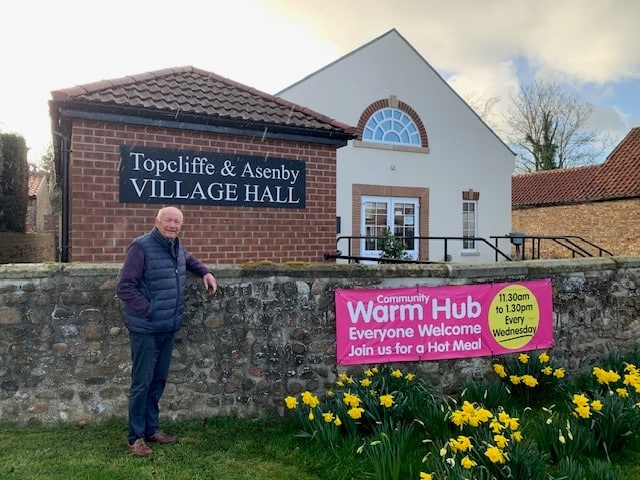
Hear from Village Hall volunteer, Doug Allan, as he reflects on his role as Trustee of Topcliffe & Asenby Village Hall.

My name is Doug Allan and I am 75 years of age. I am a Trustee of Topcliffe & Asenby Village Hall, which is located in Topcliffe near Thirsk. I have been on the Village Hall Committee for eleven years and I have no specific title but tend to be a general ‘dogs body’, organising a wide range of fundraising events and undertaking lots of tasks that help the hall run smoothly.

The Big Project

In 2014 the Village Hall Committee embarked upon an ambitious plan to extend and refurbish the premises. I was asked to join the committee in a co-opted capacity to lead on raising the huge amount of funding to enable the development to proceed. The total investment was over £140,000, most of which was grant-aided by a wide range of organisations and by local community fundraising.

Fundraising Success

The major refurbishment was completed in 2016 and by that time I had effectively been embedded in the committee and was persuaded to remain as a member. Over the years we have raised thousands for Village Hall funds by organising events including the annual Race Night (the one held in February this year raised £3,500), bringing bands to perform in the hall and lots, lots more.

Village Events

Being retired obviously means that I have the time to invest in helping and supporting the Village Hall, which I believe is an invaluable community hub. It is great to be a part of the committee and to ensure that the facility is available to villagers and people from further afield to organise a fantastic variety of activities, including our extremely successful Warm Hub lunches, bingo sessions, scouts/cubs/squirrels meetings, knit & natter sessions, boccia, art classes, weekly quiz, a wide range of Christmas activities and many private party hires.

Why volunteering matters

I have enjoyed volunteering within the community in which I live and socialise. Through the Village Hall I have made many new friends and have thoroughly enjoyed keeping busy and organising events for everyone to enjoy…whilst at the same time raising the much-needed funds that help secure the future viability of our community hub.

Find out more about Village Halls Week 2025 and how to become a volunteer.

This week we’re celebrating Village Halls Week (23 – 29 January) – a time when we recognise the vital contribution that village halls and community buildings make to our communities. This year’s focus is on how halls make their spaces warm, welcoming and inclusive. Here, Deborah Hodges, Chair of Grewelthorpe Village Hall, tells us how they’re doing just that.

Grewelthorpe Village Hall is a lively hub at the centre of the Village. Our volunteers provide a huge range of activities for the local community, as well as putting on events which attract visitors from further afield.

We pride ourselves on offering a ‘warm welcoming, inclusive space’, in a variety of ways:

Hackfall Cafe is entirely volunteer-run:

  • It is a friendly, welcoming place with a delicious menu of mainly homemade goodies, such as soup, cakes, traybakes and scones (including the widely acclaimed Hackfall Scones, made with wild garlic from the woods), with paninis and sandwiches also available. Everything is sold at very reasonable prices. We operate on a not-for-profit basis – all proceeds going back into the upkeep of the hall.
  • Once a month, our volunteers provide a two-course community lunch, at a very affordable price. This enables people to get together for lunch, with friends and neighbours, without having to travel any distance.
  • The Cafe is a great place to feel connected to the whole community. New people in the village and the surrounding area, make lasting friendships there. Residents who are less mobile or who have health difficulties, can rely on a helping hand to come for a coffee or lunch. And, our volunteers find they have a regular and enjoyable opportunity to use their skills and talents.
  • We welcome young people to our volunteer team, and are keen to offer work experience opportunities, either as part of the Duke of Edinburgh Award programme or as an introduction to the world of work.

Other activities:

  • Our Cafe Talks are thriving. We have a huge pool of local talent and expertise, which we exploit on a monthly basis!  Everything, from lovingly restoring a Grade 2 listed house to riding for the disabled, farming in Romania, walking up Mont Blanc, cycling from Landsend to John O’Groats … and much more! The speakers give their time free of charge, and we ask for a small contribution from the audience, which includes a glass of wine or a soft drink. It gives the community the chance to spend an evening in a convivial group, being entertained by one of their neighbours. All proceeds again, go back to the hall.
  • Clubs and Societies:  National groups, such as the British Legion and the WI meet in the village hall, at concessionary rates, but we also have a growing number of local societies:  Knit and Natter; Book Club; Art and Craft Group; Music Appreciation; French and Spanish Language Classes;  Gardeners’ Club; French and Spanish Art Talks.
  • Fundraising events are crucial to our survival, in these tricky times. For example, we are lucky again, to be able to rely on our very successful music events, which are incredibly well supported. The organising team have brought some great artists to Grewelthorpe, and continue to do so!
  • The Big Village Quiz makes a welcome return this month too, having been a casualty of COVID 19.  Again, all volunteer-led, and accessible to the whole community.

Grewelthorpe Village Hall relies on the support of the local community, and on its energetic, dedicated, talented team of volunteers. We are also delighted to see visitors to the village. Lots of walkers and cyclists can be sure of a friendly welcome in the Café, with plenty of information and advice available on Hackfall itself, and other places of interest.

Please visit our recently updated website, which is project-managed for us by two of our volunteers, for more information.

Together, we believe we make it a ‘warm, welcoming and inclusive space’.

This week we’re celebrating Village Halls Week (23 – 29 January) – a time when we recognise the vital contribution that village halls and community buildings make to our communities. Community First Yorkshire trustee, Jan Thornton reflects on how village halls and community buildings have been central to her life.

It is hard to imagine what my life might have been like were there not a village hall or community building in the village where I was brought up or currently live in….

As a young child, my first years at infant school were in an old building, which subsequently became repurposed for community use when the new infant and junior school opened in the late 1960s. I remember subsequently attending dancing classes there and also Brownies and Guides in the church hall.

My husband and I, as a newly married couple in the late 1980s, moved to the village where we still live. The village hall has been central to my life within the community ever since and barely a week has gone by in over 35 years where I haven’t been taking part in one activity or another there.

It has been the venue in which I have volunteered, worked hard (!), made friends and met up with neighbours. It is a great space to participate in and feel part of the community in which I live. I am very lucky: our village hall was newly built with a grant from Sport England only a couple of years before we moved there. It has been well maintained and ‘kept up with the times’ over the years by the volunteer village hall committee, so that it is still an attractive and warm place to visit and a delight to spend time in. It is so important where possible to manage a community building in a sustainable way so that it can continue to be an attractive venue for community use. Cold, damp and musty halls are hard to visit and support!

Obviously it is much harder this year than ever before to manage energy bills for community buildings. Energy advice is available on the ACRE website. There is also information available on how to apply for the Rural Community Buildings Loan Fund which is managed by ACRE on behalf of the Department for Environment, Food & Rural Affairs (DEFRA) which helps community buildings fill temporary gaps in funding, either for specific projects or for urgent work connected with the building. Last year, government announced a new £3m Platinum Jubilee village hall improvement fund, which will provide grant funding over three years (to 2025) to support capital improvement projects for village halls, such as installing Wi-Fi, extending buildings and modernising facilities, with 125 village halls set to benefit.

At Community First Yorkshire, we provide practical guidance and rural advocacy to trustees, employees and management committees of rural community buildings. Support is available on a range of topics including: good governance; safeguarding; finance and funding; policies and procedures and operational good practice. If your hall needs some improvement, there is advice and support on funding opportunities available.

Finally, a big thank you to everyone who manages and maintains rural community buildings across Yorkshire.  It is a significant responsibility but so worthwhile for the life enhancing richness they provide to those who live in your community.

#VillageHallsWeek

I have an allotment. I love my allotment; I was lucky enough to get it just before lockdown and it provided a great place to go when there was no-where to go. Being in the open air and close to nature after a day’s work is a brilliant way to relax and let my mind wander after hours of intense concentration.

In June, some of the birds get very brave and come close whilst I’m weeding to find bugs and worms for their young. Last week a blackbird came so close I grabbed a worm in my hand (gloves on!), held it out, and waited very patiently for it to come and take the worm out my hand. It hopped within inches a few times and fluttered away, but the third time he snatched it, flew a few yards away, pecked it once, then flew onto my strawberry patch, and you guessed it, ate my first ripe strawberry of the season!

I leapt up and scolded him as I would a naughty child. How dare he?! I’d just given him a lovely fat, juicy worm but he rejected that. Maybe, like most of us, he has a sweet tooth/beak. Needless to say, I immediately netted the strawberry bed.

The next day I went to the allotment and was passing the strawberry bed when I saw Mr Blackbird’s Mrs in the strawberry bed. I was incredulous! How did she get in there? I tried to un-net a section to allow her out but she squawked her way up to the other end of the bed and escaped though a tiny gap.

I thought I’d safeguarded my strawberries but it made me look afresh at my netting technique. I went round the bed tightening and weighing down the net so there were no gaps.

How are the safeguarding procedures in your Village Hall? Are there any gaps? Do you need to “tighten your nets” to ensure you are protecting those most vulnerable?

If you want to make sure your netting is secure, come along to our online Community Building and Village Hall network meeting on Wednesday 25 January 10am – 11:30am where we will be exploring what trustees should know and do regarding safeguarding in village halls. There will be a chance for you to ask questions and share good practice with others in a similar role .

I also recommend looking at our  safeguarding resource, which provides a checklist for essential and good safeguarding practices in your organisation.


Hilary Ashton, North Yorkshire Development Officer

If you were renting out your property, you would very sensibly ask potential tenants to sign a rental agreement. It’s common practice to have one so that both parties know what is expected of them.

The same applies to hiring out your village hall – having a hire agreement is an important part of protecting your vital community asset.

  1. 1. Why you need a hire agreement

Whenever a community building or village hall management committee hires out any part of its premises, it is important to have a written agreement in place so that both the management committee and the hirer know their rights and responsibilities.

  1. 2. Start by putting together a hiring policy

This should include a summary of all the decisions the management committee makes about the various aspects of hiring out your building. You should revise and review your policy regularly to keep it up to date and relevant.

  1. 3. What to include in a hiring policy

Your policy should include an explanation of the booking secretary’s role and responsibilities; when discounts or special rates for hirers are available; information about bookings, such as ensuring that hirers book enough time for setting up and clearing away; any other issues, such as whether to charge for village consultations or public meetings.

When you have your policy in place, you can then move onto drafting the hire agreement.

  1. 4. What to include in your hire agreement

The hire agreement should have two parts.

Part one includes the details specific to a particular booking and part two describes the standard conditions of hire which are the same for all bookings.

Having a comprehensive agreement which is signed by hall representatives and the hiring organisation before an event should ensure those using the building fully understand the requirements of the management committee.

  1. 5. Where to find out more about hire agreements

If you want to find out more about what to include in the hiring policy and agreement for your community building, come along to one of our Community Building Network meetings in November. These meetings are for trustees managing community buildings across North Yorkshire and give you a chance to ask questions and share good practice with others in a similar role.

written by Debby Richardson from Glusburn village hall

At Glusburn Community and Arts Centre, a large, busy, multi-room community venue, we have many activities which take place on a weekly basis.

As in most village halls in most villages across the country, we host a variety of classes/activities – yoga, playgroups, art classes, dog training and more, something for all ages and interests. However, one great advantage of our venue, a Victorian Institute erected by the local mill owner for the villagers, who were mostly in his employ, is that we have a 215-seat theatre space with a proscenium arch stage. Throughout the year, our stage plays host to performances from local groups and national touring artists. We are home to the longest-running annual Scouts Gang Show in the UK, and the pantomime with flying ballet performed by our resident company Glusburn Youth Theatre. These shows are wonderful, showcasing the talents of local children and entertaining packed houses.

It’s always a treat to host touring theatre, and we are very lucky to have Falling Stars Theatre, founded by Director Rebecca Durham, almost on our doorstep. Their pieces are often an immersive style, staged on the auditorium floor surrounded by the audience and involving them in the performance. For Christmas 2021, when our audience capacity was reduced to about 45 due to coronavirus regulations, Beccy penned a reimagining of The Snow Queen and we worked together to bring this to several socially-distanced audiences.  Their village hall tour of Here I Belong was cut short by the first lockdown in March 2020 – we’re delighted that it will finally be performed here two years later than planned on 25th March 2022. We’re also bringing some comedy to our audiences this year from York-based Bad Apple Theatre, a not-for-profit group who are supported by Arts Council England.

Live music is another key aspect of our programming – we book a mix of local artists, touring tribute acts and well-known names – this sort of show was just impossible when we first reopened but once capacity limits were lifted it was clear that audiences were keen to get back to ‘live’ and we had great ticket sales for our first three acts of the season – David Bowie and Frankie Valli tributes and a local Motown covers band, Soul Train. We’re looking forward to welcoming back Snake Davis (twice postponed) and The Houghton Weavers in the spring, and we’re in the process of finalising arrangements for Kiki Dee later in the year. We’re always working a long way ahead in the diary planning the next season before the current one is halfway through.

Film screenings are held monthly throughout the year. Like other village halls, we can’t get new releases and have to wait until films are released on DVD – we work with Film Bank for our licensing. The increase in the use of subscription channels like Netflix, Disney and Prime mean, of course, that many people have had the opportunity to see films at home even before the DVD release, but seeing something on a big screen as part of an audience, enjoying a couple of drinks from the bar, definitely adds to the experience and our figures still make this aspect worthwhile. To expand on this, we’ve recently started working with CinemaLive who is a distributor of ‘event cinema’. Through them, we have screened live recordings of Ball & Boe, The Australian Ballet, and this weekend we have Cliff Richard on tour! In Glusburn?!

To be able to run our busy venue, alongside a team of dedicated trustees, we do employ a part-time Centre Coordinator who looks after room and event bookings, tickets, publicity and all the other day-to-day tasks. Still, we rely heavily on support from our wonderful volunteers – we simply couldn’t do everything we do without them. Volunteers can help in so many different ways – distributing posters, setting up events, serving at coffee mornings or on event bars, checking tickets on the door and stewarding in the auditorium, running the technical aspects of events, supporting art classes, looking after the garden – we even have a volunteer clock winder! If you want to grow what you do in your hall, particularly in terms of putting on more events, reach out to your community for volunteers to help you do that.

Don’t be put off if your first attempts aren’t a roaring success – take stock, gather feedback, look at what did work, and try again.

Good luck!

Written by Joanne Abbott, development officer at Community First Yorkshire.

Why compile a fixed asset register for a community building?

You may have looked around your community building or village hall on a number of occasions and thought “I wonder how long that boiler will last”, “How many years will it be before the windows need painting?” or “Can we afford to replace those old chairs next year?”!

An up to date asset register could help you answer all these questions and more.

A comprehensive list of all assets and fixtures and fittings will provide you with information, all in one place, to help you make well-informed decisions relating to maintenance and replacement.

One of the 6 main duties of a charity trustee, as defined by the Charity Commission, is to manage the charity’s resources responsibly.

Having a register of the charity’s assets will help trustees fulfil this duty.

An asset register will help trustees:
  •  Know what assets the charity owns
  •  Know where those assets are located
  •  Plan for when renewals may be needed and how much they may cost
  • Compile a reserves policy
    • Designating funds to cover the future cost of replacing items
    • Explaining the reason for holding funds in reserve
  • Value assets for insurance purposes
What does an asset register look like?

This will depend on the assets of the charity and the number of details trustees wish to include.
A simple table or spreadsheet with a list of assets down one side and details of those assets across the top is a useful format to adopt.

For example: number of items, date purchased, cost price, date replacement needed and estimated cost of replacement across the top and boiler, tables, chairs and projector down the side.

Other useful information you may want to include in your table are:

  • Name of supplier and contact details
  • Technical specification of item
  • Location
  • Maintenance intervals
The information captured in the table should help with:
  • Setting reserves levels to ensure enough is set aside to maintain, repair and replace the building and its fixtures and fittings
  • Setting hire charges at a level to ensure sufficient income to maintain reserves levels
  • Planning fundraising activities to fill any shortfall in reserves including staging fundraising events and making applications to grant funders

It is good practice to review and adjust the asset register on a regular basis.
You will need to update the register as assets are purchased and disposed of and carrying out an annual review will help to ensure the register is kept up to date.

Hopefully, you can now see the benefits of compiling and maintaining an asset register for your community building and now have an idea about how you can make a start.

‘What the Dickens’ is a community library loaning service based in Monk Fryston and Hillam Community Centre. The project was founded by Sue Woodall.

This project began with contracts for room hire, the completion of permanent and secure shelving by local craftsmen and with an initial store of around 500 books, some borrowed from the Central Library at North Yorkshire County Council, ‘What the Dickens’ was launched successfully in February 2020.

Within the first month of opening fifty members were registered! Unfortunately, like most community projects, it suffered a temporary pause during the national lockdown. But, since reopening in June 2021 they now have a register of one hundred and ten and continue to grow.

With such a rollercoaster of a start, we took some time to speak with the founder of this community project, Sue Woodall.


Sue, what did you want to do, or achieve, when you started the project?

Very simply to stimulate the love of reading from nine months to ninety years.

That sounded like a rocky start, opening up a month before a national lockdown. Did you ever feel like giving up?

Not give up but some things were daunting. Like finding the people with the right skills to help us. Setting up the structure to be able to apply for grants – having bank accounts, constitution, organisation and premises in place or lined up and convincing the Funders to back the idea.

Have you had any surprises?

How, despite the pandemic, we have become a part of some people’s lives by not only supplying books but providing regular contact and social interaction. Like friendships being formed, sometimes between people who were near neighbours but did not know each other

And finally – some kind and well-intentioned people thought we might like to take their old magazines and dog-eared books off their hands – we have learnt that what people want is a range of good quality novels by popular authors and biographies. We are not paper recyclers – we provide easy access to your door-step library and drop-in service.

We could not have done it without the generous donations of good quality books from residents, the support of our clients and the organising group.

What would you like to do next?

I would like to get more people of all ages, particularly teenagers reading books.

I would like to get members to write appraisals of books they have read which we could share via our Facebook page and get people to meet and discuss books.

Perhaps this would lead to a book club – where members could meet, share their views of a book they have all read, and socialise as well. NY Libraries would be willing to provide multiple copies of books for a group to read simultaneously.

We need to look at the room we occupy to perhaps provide a better ambience with comfortable seating and décor to encourage socialising.

The success of ‘What the Dickens’ has led to an add-on service: a permanent display of books for the under-sixes that encourages parents attending other groups using the community centre when What the Dickens is closed, to bring and swap books. It has been named Tiny Tim’s Swap Shop and is now regularly attended on a Wednesday by children from Monk Fryston Pre-school.

Further grants and generous donations from locals has enabled the community library to restock their shelves with new reading materials.

What the Dickens has achieved its goal of reaching out to all ages in the community by providing a relaxing environment in which to read and forge new friendships. As we came out of lockdown it became a major part of the fabric of our village and, as society adapts to the new restrictions imposed upon us, it is with confidence that the library and its users can look forward to an even brighter future.

Opening times Wednesday 10.30am – 12.30pm and Sunday 2pm-4pm

  • No borrowing charges
  • Light refreshments offered – tea, toast and scones at a nominal charge

For further information, head to the ‘What the Dickens’ Facebook page that offers weekly updates on opening times and book reviews of new library acquisitions.

To celebrate Village Halls Week 2021, our Chair of Trustees, David Sharp, tells us about the importance and relevance of village halls and why they deserve such celebration.

So we all know where our local village hall or community building is don’t we!

For those of you that do and use them on a regular basis, you know their importance, the value they bring and the sense of community they create.

For those of you that don’t, perhaps by reading this you will go out, when lockdown allows, and find out what’s going on and hopefully get involved.

Village halls have been providing amazing community based services and support for over 100 years. The diversity of activities that take part in village halls is astounding, from Scouts and Guides, WI, lunch clubs, Weight Watchers, bridge clubs, parties, national celebrations and the list goes on. They provide the location for the weird, wonderful and exceptional as well as the essential to take place in rural localities.

The lifeline that the different activities create for the vulnerable, lonely and isolated, as well as the community spirt generated through regularly meeting up to participate in your favourite activity, cannot be underestimated.

Clearly the government 100 years ago saw the benefits and as such created an initiative to support the rural communities following the Great War. This helped set up the first Rural Community Council in Oxfordshire. Yorkshire wasn’t slow to take this initiative up and created its own in 1928. During the next few years, hundreds of village halls were built, refurbished and brought back to life. Today there are over 600 that are over 100 years old. How many other local businesses can say they are over 100 years old – not that many!

They have been tested, the War to follow the Great War, apparently there was a 60’s if anyone can remember it, oil crisis in the 70’s, Yuppies in the 80’s, Brit pop in the 90’s, War on Terror in the 00’s and now Brexit and a global pandemic.

So that tells me that not only are they really needed but also incredibly resilient. That is down to the amazing volunteers involved in village halls, giving thousands of hours of time to make sure that Granny Sharp has everything she needs for her 90th birthday party to sweeping the floor so the ballroom dancing class can glide effortlessly across the polished floor.

In Yorkshire we have over 900 village halls which are being looked after by volunteers and Village Hall Week is all about celebrating them. So my thanks to each and every one of you involved in village halls, be that staff, volunteers or patrons. Your commitment, passion and enthusiasm for making your village hall the hub of your community is greatly appreciated and although we only have Village Hall Week once a year, every time the doors open should be celebrated because of the work needed to do just that.

To find out what’s happening during Village Halls Week 2021 visit the ACRE website.

If you would like to write a blog about your village hall, please get in touch, we’d love to hear from you!

Find out what support we can offer village halls and community buildings here.