

Please introduce yourself
My name is Leo Thai, I volunteer at WHISH (Whitby Hidden Impairments Support and Help). I’ve volunteered there for just over a year and my role is now a Qualified Youth Worker.
What attracted you to the organisation and volunteer role?
I was involved with the organisation initially as a parent. Having experienced first hand the fantastic work that they do, and how much they have helped me and my family, it was impossible for me not to want to give something back. It was a small start, a few hours here and there and I felt welcome from day one.
What would you say to anyone thinking of volunteering?
I can only speak from experience. That old saying of what you give in life, you get back – as I said, I wanted to give back by volunteering as a way of saying ‘thank you’ – and it changed my future. What started as a few days volunteering has so far turned into new experiences, happy memories and brought me into contact with new friends and fantastic people. It has also lead to paid employment in a new field of work that I love. The skills I have learned are so varied and help me and others. I really can’t believe how things have changed for me in just over a year through volunteer work.
My advice would be find something you believe in and feel passionate about, start your volunteering journey and see where it goes. You won’t know until you start!
What was the best piece of advice given to you as a volunteer?
I can’t pick one piece as I get so much great advice from many different sources at WHISH. As well as helping others, volunteering is also about learning and gaining experience – so if I need to know anything I just ask the right person. If you are the right fit for the organisation you should get all the advice and support you need.
Finally, tell us something about yourself that your fellow volunteers would be surprised to know
I don’t know if it’s a surprise to anyone but I love writing. My three favourite subjects are politics and political theory, Aston Villa FC and nostalgic humour, if that’s actually a thing. I could read a newspaper by the time I was 3 years old, but still left school with no formal qualifications.
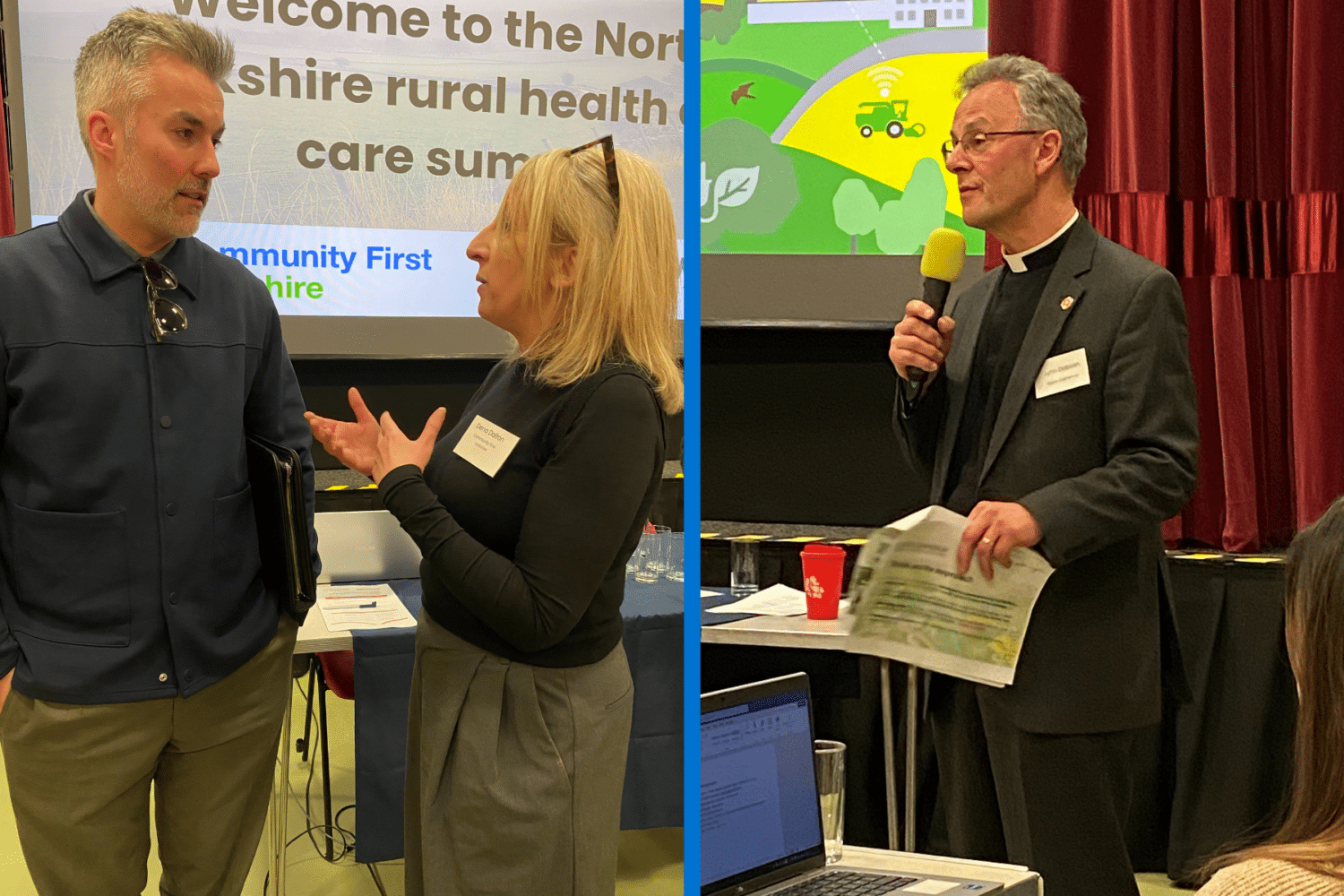
On Friday 21 March, leaders from the NHS, North Yorkshire Council, the VCSE sector, rural organisations and our national parks, gathered at the Galtres Centre in Easingwold to explore a shared understanding of rural health inequalities and how we can work better together to address the impact of them. Organised by Community First Yorkshire and Healthwatch North Yorkshire, the North Yorkshire Rural Health and Care summit was a dynamic discussion on rural healthcare challenges and solutions.
Dena Dalton, Head of Health Collaboration at Community First Yorkshire, shares her thoughts about the event.
Rural healthcare: more than just medicine
One key theme from the summit was that rural healthcare isn’t just about improving access to healthcare services. Transport, digital access, community support, housing, and infrastructure all play critical roles in health outcomes. When it does come to healthcare though, many rural residents feel ignored, as Ashley Green, CEO of Healthwatch North Yorkshire, pointed out.
Access is a major issue – people often have to travel 50+ miles for hospital appointments, and there is a shortage of local GPs. Community transport services are a lifeline – where they are funded to exist, yet digital connectivity remains a challenge. Poor broadband access limits online healthcare services, which are becoming increasingly essential.
The cost of rural healthcare
Providing healthcare in rural areas is more expensive than in urban settings, especially given the higher proportion of older adults. York and North Yorkshire Combined Authority Mayor, David Skaith, reiterated the importance of housing and transport in improving health in rural areas and is developing ways to address these. Additional new interventions from the authority include a Men’s Mental Health Task Force and plans to establish a Sports Council to promote early intervention in health issues.
Richard Webb, Corporate Director of Health and Adult Services at North Yorkshire Council, reminded us that older residents are vital in keeping communities connected. He challenged stereotypes about ageing and emphasised that rural inequalities look different and require specific attention. He also suggested that rural housing should be commissioned in partnership with VCSE organisations.
Rural isolation and mental health
Debbie Swales, CEO of Revival North Yorkshire, shared a moving account of how older people in rural communities experience isolation, leading to poorer health outcomes. As she put it, rural North Yorkshire may look like a ‘chocolate box’ environment, but for the elderly, the view often changes – and not always for the better.
The Very Reverend John Dobson, Dean of Ripon and Chair of the North Yorkshire Rural Commission highlighted the mental health struggles of farming communities. He called for the government to recognise digital connectivity as a fundamental right and to scrutinise rural strategy with a health focus. Without affordable housing, many rural communities risk decline.
Challenges in primary care
Simon Stockhill, GP and Chair of the Humber and North Yorkshire Primary Care Collaborative, illustrated the daily reality for GPs, pointing out vast geographic disparities in doctor availability. Scarborough, for instance, has significantly fewer GPs per capita than Harrogate. He emphasised the importance of integrating primary care, communities, VCSE organisations, and care sectors to address health inequalities effectively.
Helen Flynn, CEO of Nidderdale Plus, noted the increasing demand for digital support, as many older people struggle with the shift to online healthcare services. Meanwhile, Ivan Annibal from the National Centre for Rural Health and Care identified workforce shortages as the most pressing issue in rural healthcare. The cost of living in rural areas is high, making it difficult to attract and retain healthcare professionals.
My key takeaways
The lively panel discussions and table debates throughout the summit led to some clear conclusions:
- No one should be disadvantaged by where they live
- Rural healthcare is complex and varies by location
- Innovation is key in rural health, and risk-taking is necessary
- Rural communities are valuable resources that need greater support
- Addressing rural deprivation requires stronger advocacy
- We must push for better rural housing to improve health outcomes.
What’s next?
Insights and feedback from this summit are still being collated and will feed into a dedicated rural health and care plan. At the event, there was a commitment to revisit the Rural Commission’s findings, ensuring health plays a larger role in rural strategy. Councillor Michael Harrison, chair of the North Yorkshire Health and Wellbeing Board, thought this was also a good opportunity to reset the Board. All partners present committed to supporting change in some way, including building on new connections made, developing further knowledge through shared resources, and looking at ways in which secondary care can support in making appointments more accessible to rural populations. We will keep you posted as to what more comes from it.
If you want to discuss the event in more detail, please email Dena Dalton, Head of Collaboration at Community First Yorkshire.