useful data
to gather the information
you need without overwhelming
your team or the people you support.
Different information serves different purposes
Types of data you can collect
You may already gather some of this as part of your normal delivery.
User data
Information collected when someone registers or accesses a service, such as age range, location or eligibility.
Engagement data
Attendance, repeat visits, downloads or use of an online resource.
Feedback data
People’s views about an activity or service, gathered through comments, polls or forms.
Outcome data
Information collected over time to show whether knowledge, confidence, behaviour or wellbeing changed.
Impact data
Evidence of longer-term change. This level of measurement is not always necessary for smaller organisations.
Two complementary forms of evidence
Combine numbers with people’s experiences
Quantitative and qualitative information answer different questions.
Quantitative data
Numerical information that can be counted or measured.
- number attending
- percentage reporting an improvement
- frequency of service use
- before-and-after scores
Best for: showing scale, reach and measurable change.
Qualitative data
Descriptive information that captures people’s experiences, views and stories.
- comments and quotations
- interview responses
- case studies
- observations and creative work
Best for: explaining how and why change happened.
Choose methods that suit your audience
Ways to collect useful information
Consider what people will find accessible, comfortable and realistic.
Surveys
Surveys can collect both numerical and written feedback. Keep them short, use clear language and only ask questions you intend to use.
Useful when: you need consistent responses that can be compared over time.
Interviews
Interviews let people explain their thoughts, feelings and experiences in their own words.
Useful when: you want detailed insight into how support affected someone.
Focus groups
Small group discussions can reveal shared experiences, differences of opinion and ideas for improvement.
Case studies
Case studies show what change looks like in real life. Use consent, protect privacy and avoid suggesting one story represents everyone.
Creative methods
Drawings, photographs, audio and video can help people express experiences that are difficult to capture through formal questions.
Observations
Staff or volunteers can record agreed observations during normal activities. Use consistent prompts and distinguish observation from assumption.
Make collection manageable
Sampling and sample sizes
You do not always need to collect information from everyone you support. Sampling helps you gather useful evidence in a realistic and proportionate way.
What is sampling?
Sampling means collecting information from a smaller group of people, rather than from everyone who uses your service or takes part in your activity.
In many voluntary, community and social enterprise settings, it is not practical or necessary to ask every person for feedback or outcome information.
A sample might include:
- all participants in a single programme
- a random selection of service users over a period of time
- a targeted group, such as young people, carers or first-time users
Why sampling matters
Sampling can help you gather evidence without overwhelming staff, volunteers or the people you support. It helps you collect information in a manageable way while still gaining insight into impact and outcomes.
What it can and cannot show
A sample tells you something about the people you heard from. It does not represent everyone perfectly, so be clear about who responded and what this means for your findings.
There is no fixed number
The right sample size depends on the size of your service, the type of work you deliver, your resources and what you are trying to understand.
Small samples can still be useful
Small organisations can produce useful and credible evidence using small samples, case studies and repeated feedback over time.
For smaller services, even 10 to 30 responses can be meaningful, especially when they are combined with qualitative evidence such as interviews, case studies or staff observations.
How to strengthen small samples
- collect information consistently over time, such as quarterly feedback rather than a one-off survey
- combine methods, such as surveys, interviews and case studies
- check findings against other evidence, such as staff observations or national datasets
- be open about how many people responded and how they were selected
Use clear and credible questions
Measuring wellbeing impact
If your work focuses on wellbeing, you may want to assess changes in how people feel, cope and connect with others.
Use recognised tools where possible
Where possible, use recognised wellbeing questions or measurement tools. These have been tested and are more likely to produce reliable and meaningful results.
Using recognised tools can help you:
- benchmark your results against wider populations
- strengthen the credibility of your findings
- avoid poorly designed or leading questions
- report more confidently to funders and partners
For example, Mind has published this useful guidance: Tools for measuring changes in mental health and wellbeing.
Respect people and protect information
Collect data responsibly
Only collect information you genuinely need, explain how it will be used and keep it secure.
Be clear
Tell people why you are collecting information and who may see it.
Ask for consent
Use appropriate consent for interviews, case studies, photographs, video and quotations.
Collect less
Avoid personal or sensitive information unless it is necessary for a clear purpose.
Store it safely
Limit access, use secure systems and agree when information will be deleted.
Turn ideas into a manageable process
Create a simple data collection plan
Agree what will be collected, how it will be gathered and who is responsible before delivery begins.
| What do we need to know? | What will we collect? | Method | Who from? | When? | Who is responsible? |
|---|---|---|---|---|---|
| Are participants feeling more confident? | Confidence rating and explanation | Brief before-and-after survey | Workshop participants | First and final sessions | Project officer |
| What helped people most? | Comments and examples | Discussion or interview | Small sample | End of programme | Volunteer coordinator |
| How many people did we reach? | Attendance and repeat participation | Registration records | All participants | Every session | Administrator |
Before you begin collecting
Data collection checklist
You are ready to move forward when these points are clear.
We know what we need to learn and why.
We have chosen methods that suit the people involved.
We are collecting a proportionate amount of information.
Roles and responsibilities are clear.
Privacy, consent and secure storage have been considered.
We know when the information will be reviewed and used.
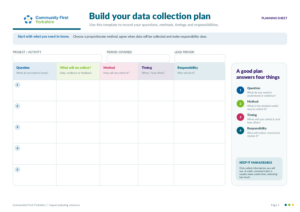
Build your data collection plan
Use this downloadable template to record your questions, methods, timings and responsibilities.
Next guide
Understand your findings